
The Gunk vs. The Wand: Time to Ditch Your Impression Trays! (An Honest ROI Look)
We crunch the numbers on the “Digital Dentistry” hype to see if the switch is finally worth the hassle for the average dental practice in 2025.
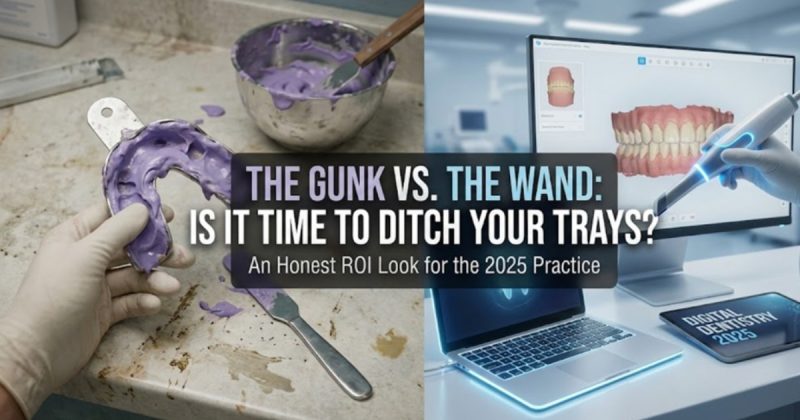
Let’s be brutally honest for a second. Is there any dentist alive who genuinely enjoys taking a PVS impression?
For years, dental conventions have been screaming at us that “Digital is the Future.” We walk past booths showcasing sleek intraoral scanners (IOS), look at the six-figure price tag, laugh, and go back to buying bulk alginate.
But something shifted in the last 18 months. The technology matured, and more importantly, the economics broke. We have reached a tipping point where not having a scanner might be costing you more than buying one.
Let’s break down the Digital vs. Analog debate, not with hype, but with hard realities and ROI.
The Hidden Tax of Analog Impressions
We tend to think of impression costs only in terms of materials-tubes of PVS, bags of alginate, impression trays, and adhesives.
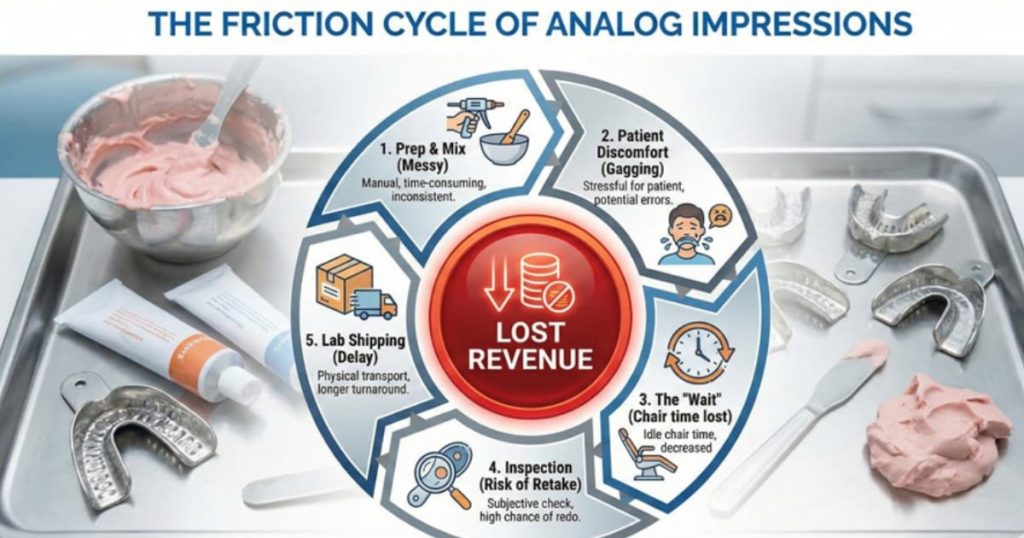
If you run a busy practice, you know materials are the smallest part of the equation. The real cost is friction. It’s the cumulative drag on your practice’s efficiency.
The 15 minutes spent on setup, wait time, disinfection, and cleanup add up. Then there’s the lab calling three days later with, “Doc, the margin on tooth 36 is unclear,” leading to a patient recall and redo. Plus, the physical space taken up by boxes of stone models that will likely never be used again.
Why are we still accepting this friction as normal?
The Digital Promise vs. The Historical Price Barrier
We all know the benefits of intraoral scanning on paper:
- Patient Wow Factor: Showing a patient a 3D color scan of their own cracked tooth on a big screen converts treatment plans faster than any verbal explanation.
- Accuracy: No material distortion, no bubbles. What you scan is what you get.
- Speed: A full arch scan in under two minutes once you master the learning curve.
- Lab Communication: Instant file transfer. The lab technician can design the crown while the patient is still getting numb.
So, why haven’t we all switched?
Simple. Sticker Shock.
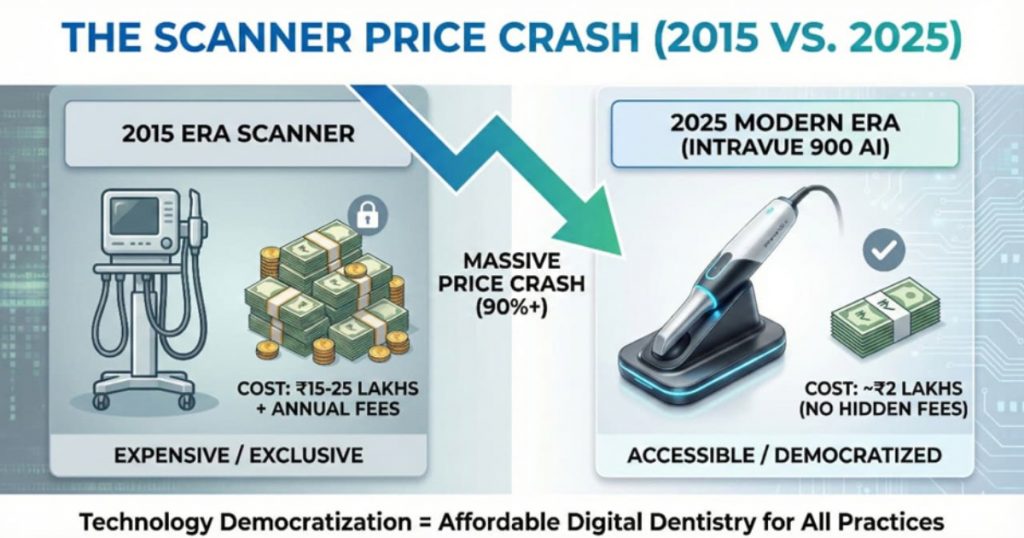
Until very recently, a reliable intraoral scanners was a ₹18 Lakh to ₹25 Lakh investment. Plus, annual license fees. Plus, expensive laptop requirements. For a massive multi-specialty centre, maybe that made sense. For a standard two-chair private practice? The math just didn’t math.
Dentists weren’t being laggards; they were being financially responsible.
The 2025 Paradigm Shift: Democratization of Tech
This is where the story changes. And it changes fast.
Just like flat-screen TVs went from costing a fortune to being available in every supermarket, intraoral scanning technology has democratized.
The patents on the early technology expired. Manufacturing became more efficient. AI stepped in to make software smarter and faster without needing hyper-expensive hardware.
The barrier to entry has crashed. We are no longer looking at the price of a luxury car; we are looking at the price of a basic dental chair.
A prime example of this market shift is the new generation of accessible scanners hitting the market, like the Intravue 900 AI available on Dentalkart.
We are now seeing highly capable, AI-driven scanners entering the market around the ₹2 Lakh mark.
Let that sink in. From ₹20 Lakhs down to ₹2 Lakhs.
When the technology becomes 10x cheaper, the ROI calculation completely flips.
The Hard ROI: Doing the Math at ₹2 Lakhs
Let’s ignore the “soft” benefits like happier patients and just look at the cold, hard cash.
If you purchase a scanner like the Intravue 900 AI at roughly ₹2,00,000, how do you justify that?
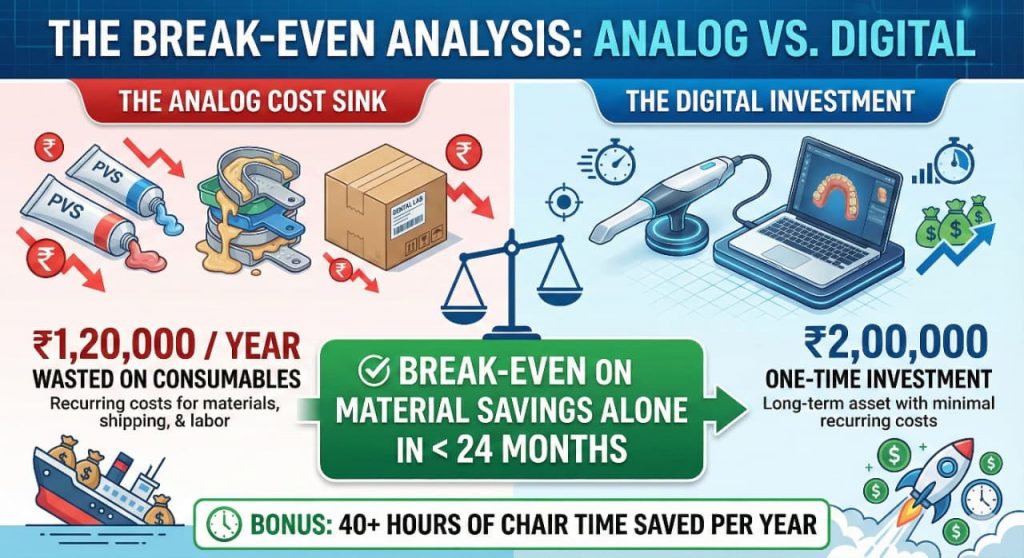
Let’s assume a conservative cost of ₹500 per impression for PVS material, impression trays, disinfection, and shipping (not including your time).
If you do just 20 crowns or indirect restorations a month, you are spending roughly ₹10,000 a month purely on impression consumables.
That’s ₹1,20,000 a year you are literally throwing in the dustbin.
At a ₹2 Lakh price point, with easily available EMI options that Dentalkart provides, the scanner payments are often less than what you currently spend on PVS materials.
The scanner essentially pays for itself in material savings alone in under two years.
And that is before we factor in the biggest asset: Your Chair Time. If scanning saves you just 10 minutes per procedure compared to the setup/set/cleanup of PVS, and you do 20 a month, that’s nearly 3.5 hours of extra chair time recovered per month. What is 3.5 hours of your time worth in production?
The New Workflow: What It Actually Looks Like
Fearing the learning curve is natural. We are creatures of habit. But modern scanners backed by AI aren’t like the complex machines of a decade ago.
The AI actively helps remove tongue and cheek data. It stitches images together seamlessly even if your hand shakes a little. It tells you immediately if you missed an undercut.
The workflow goes from messy to clinical:

The Verdict: It’s No Longer “If,” But “When”
For years, sitting on the fence was the smart business move. The technology was evolving too fast and cost too much.
But in 2025, if you are still exclusively using impression trays and gunk for every crown and bridge, you aren’t saving money. You are leaking efficiency.
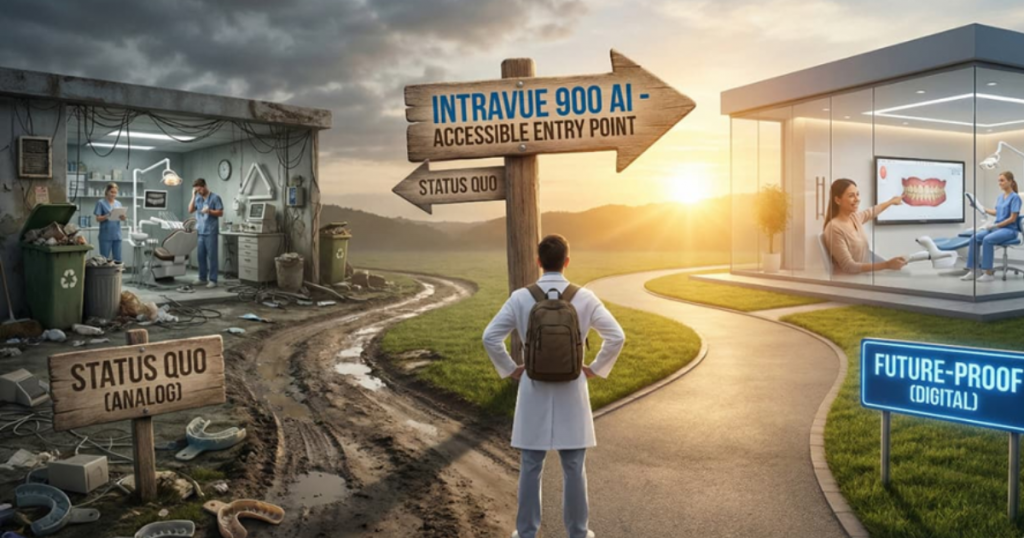
The introduction of high-quality, budget-friendly options like the Intravue 900 AI means the “elite” status of digital dentistry is gone. It’s now just a standard utility, like having an autoclave or an apex locator.
You don’t have to buy the most expensive Ferrari on the lot to get to work faster. You just need a reliable engine that gets you off the horse and buggy.
It’s time to put down the mixing gun and pick up the wand. Your patients (and your back) will thank you.
Conclusion
The debate between traditional impressions and digital scanning is no longer about preference-it’s about practicality and long-term value. With modern scanners becoming dramatically more affordable and far more efficient, the economic and clinical advantages now heavily favor going digital. Reduced material costs, faster workflows, fewer remakes, and improved patient experience all point in one direction. For the average dental practice in 2025, sticking to impression trays is no longer cost-saving-it’s an operational bottleneck. The tipping point has arrived, and embracing intraoral scanning isn’t just an upgrade; it’s the new standard for a smarter, leaner, and more productive practice.
FAQ’s
Yes. Digital impressions avoid material distortion and provide highly precise scans, improving crown fit and reducing remakes.
Most clinics recover scanner costs within 1–2 years by eliminating PVS materials, shipping, disinfecting time, and remakes.
No. Modern AI scanners guide margin capture and auto-correct errors, allowing most dentists to become proficient within a few cases.
Yes. Patients find scanning faster, cleaner, and more comfortable than traditional impression trays, improving overall acceptance and satisfaction.

No Comment