
Rotary vs. Reciprocating Files: A Clinical Guide to System Selection

Endodontic shaping has transitioned from the use of rigid stainless steel hand files to flexible nickel-titanium (NiTi) instruments capable of conforming to complex root canal anatomy. Modern NiTi files utilize either continuous rotation or reciprocating motion. The choice between this kinematics directly impacts clinical efficiency, instrument longevity, and the overall quality of the canal preparation.
Understanding the Mechanisms of Motion
Continuous Rotary Motion
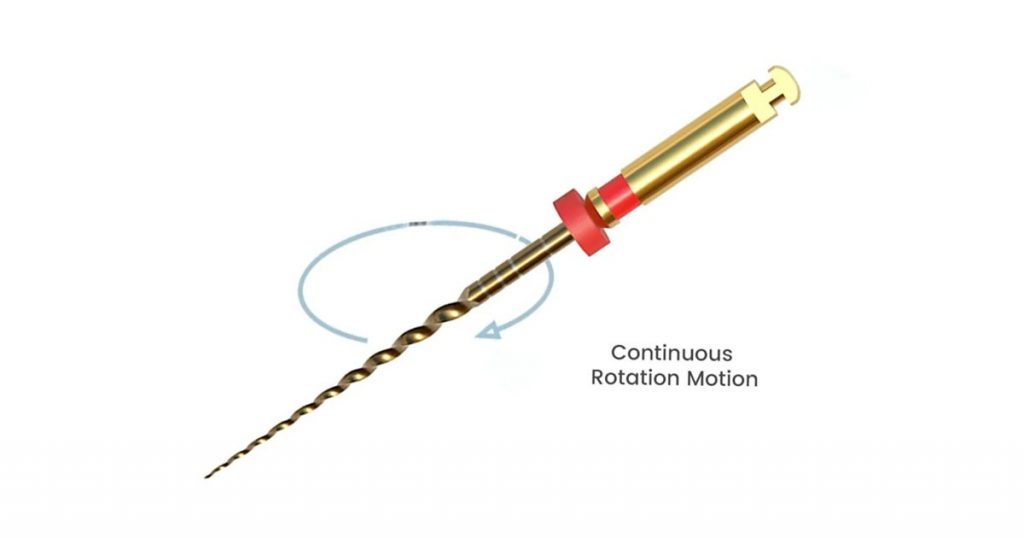
Continuous rotary motion involves the file spinning in a consistent clockwise direction. This action engages dentin along the cutting edges and facilitates the coronal transport of debris.
- Advantages: This motion produces well-centered preparations through the progressive enlargement of the canal using multiple instruments. It significantly reduces instrumentation time compared to hand files while achieving a greater taper.
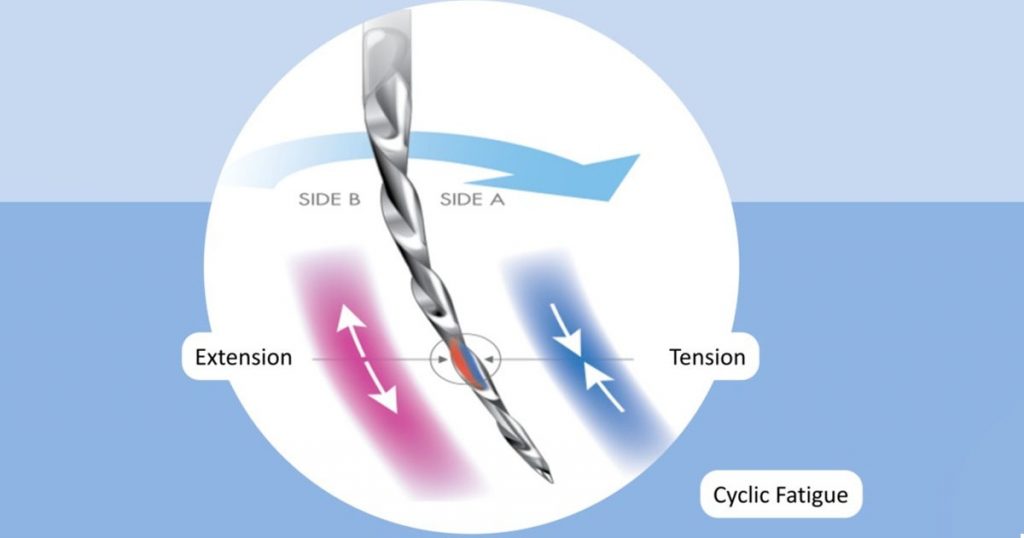
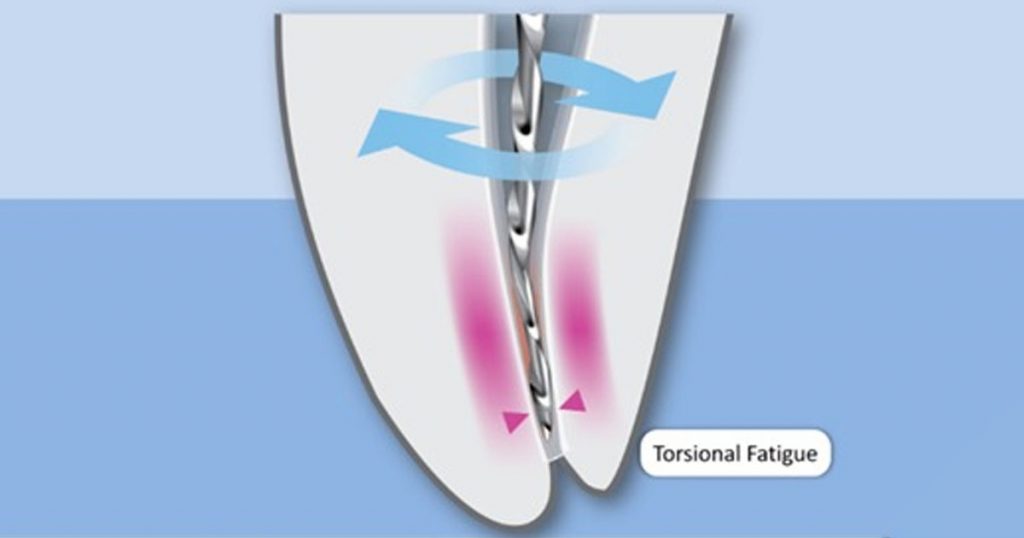
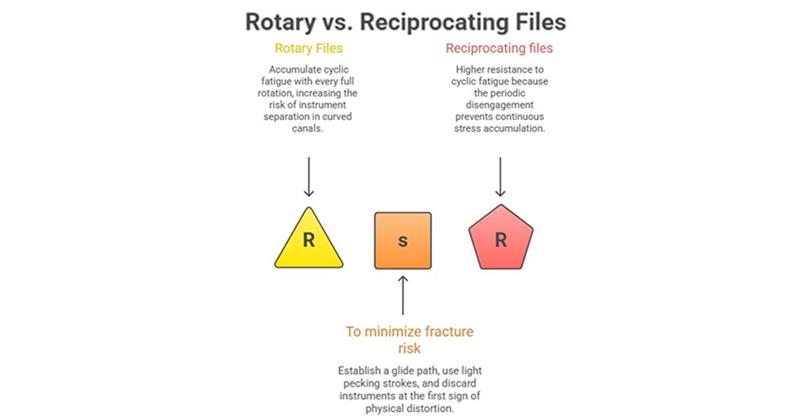
- Risks: Each full revolution subjects the instrument to torsional and flexural stress. Consequently, cyclic fatigue accumulates rapidly, particularly within curved canals. Furthermore, the requirement for a sequence of instruments increases inventory requirements and operational costs.
Products: SuperEndo Gold-Flex Rotary Files (Pack of 6), Waldent Wal-flex Gold Rotary Files 25mm
Reciprocating Motion
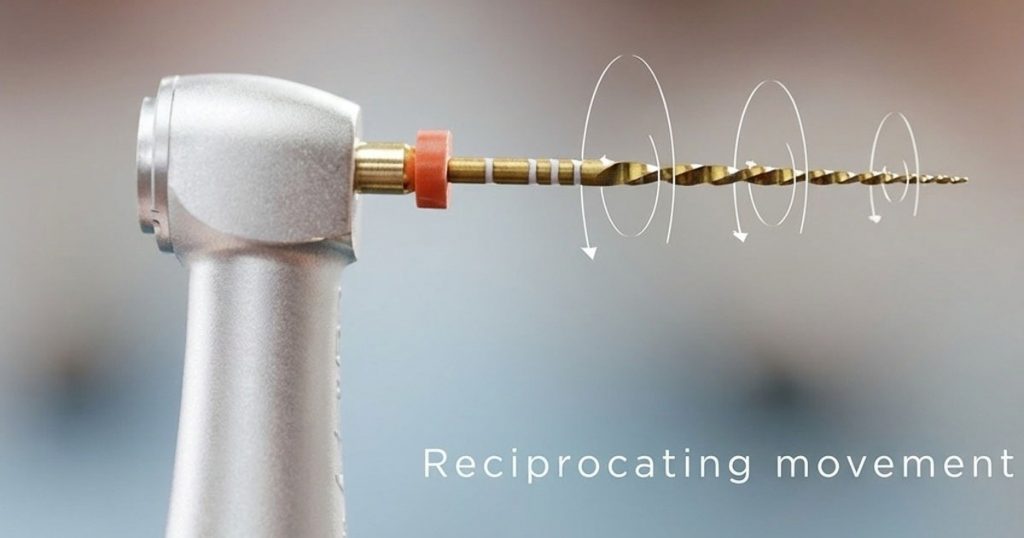
Reciprocating motion utilizes an alternating back-and-forth movement with unequal angles, typically featuring a larger counterclockwise (cutting) angle and a smaller clockwise (release) angle. A common example involves a file advancing 170° CCW followed by 50° CW; three such cycles complete a full 360° rotation.
- Advantages: The “cut and release” cycle reduces binding and torsional stress by disengaging the file with each movement, which prolongs instrument life. Most reciprocating systems are designed as single-instrument protocols, simplifying sterilization and saving chairside time.
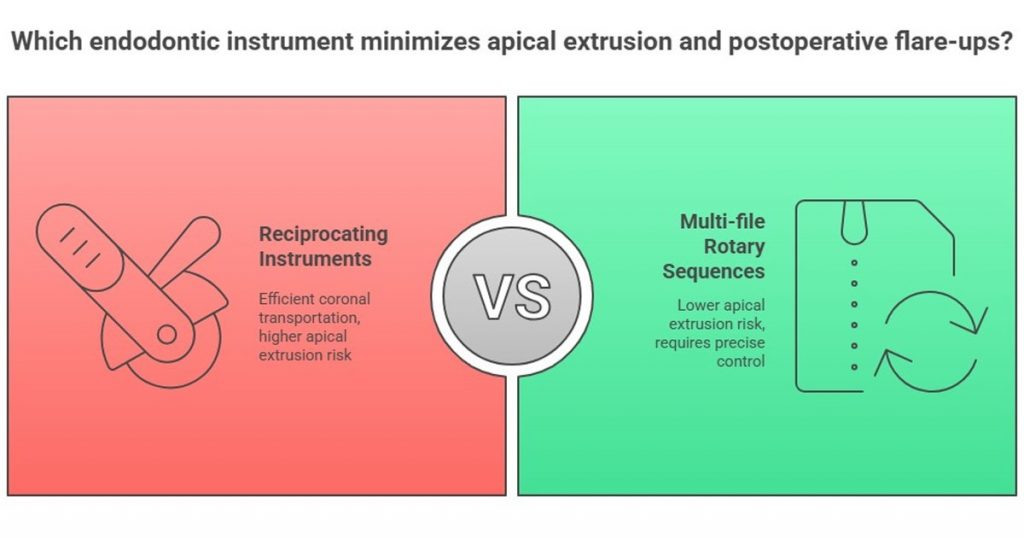
- Risks: Because a single file performs the bulk of the shaping, there is a risk of increased apical debris extrusion compared to multi-file sequences.
Products: Waldent Flexiwave Reciprocating Files (25mm), Dentsply WaveOne Gold Rotary Files Refill
Critical Factors for Clinical Decision-Making
Canal Anatomy and Complexity
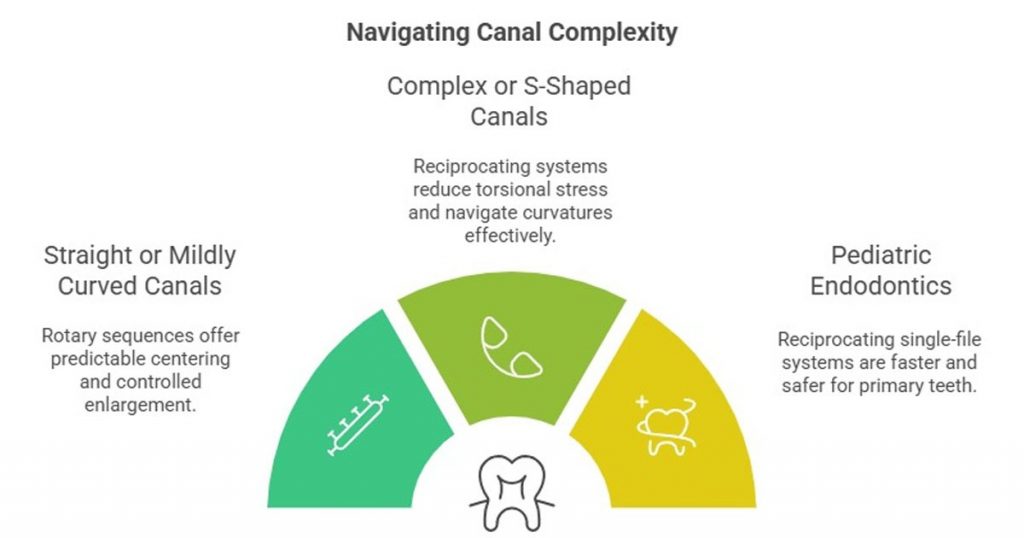
The complexity of the canal often dictates the safest kinematic choice.
Instrument Life and Fatigue Resistance
Debris Management and Canal Cleanliness
Clinical Decision Matrix
| Scenario | Rotary System | Reciprocating System |
|---|---|---|
| Simple/Straight Canals | Progressive sequences allow for precise enlargement. | Effective, but the mechanical advantages are less pronounced. |
| Abrupt Curvatures | Higher risk of binding and fatigue; requires flexible alloys. | Preferred. Reduced torsional stress; simplifies navigation. |
| Time-Sensitive/Pediatric | Multiple file changes increase chairside time. | Preferred. Single-file use shortens working time. |
| Retreatment | Slower removal of filling material. | Faster gutta-percha removal; risk of apical extrusion. |
| Tactile Feedback | Stepwise enlargement provides better tactile sense. | Requires confidence in “pecking” motion; less tactile feedback. |
| Economics | Lower cost per file; requires higher inventory count. | Higher cost per file; reduces total inventory to one file per case. |
The Hybrid Approach: Moving Beyond the “Either-Or” Fallacy
The traditional binary choice between rotary and reciprocating systems is increasingly viewed as outdated. Advanced endodontic protocols now frequently employ a hybrid approach, leveraging the mechanical strengths of each kinematic at different stages of the procedure. This methodology prioritizes anatomical safety without sacrificing the precision of the final shape.
1. Rotary for Coronal Shaping + Reciprocation Apically
One common hybrid strategy involves utilizing rotary files for the initial coronal and mid-bundle enlargement.
- Rationale: Stiffer rotary orifice shapers are highly effective at removing cervical constraints and creating straight-line access. Once the coronal third is flared, the clinician switches to a reciprocating file for the apical third.
- The Benefit: Reciprocation provides superior resistance to cyclic fatigue in the apical curvature, where the risk of fracture is highest, while the rotary start ensures a clean, wide pathway for irrigation.
2. Reciprocation for Scouting + Rotary for Finishing
In this workflow, the reciprocating motion is used to “scout” the canal and establish a mechanical glide path.
- Rationale: Reciprocating glide path files (e.g., WaveOne Gold Glider) are less likely to bind or screw into the canal than rotary counterparts. Once the canal is patent and the glide path is established, the clinician switches to a rotary sequence to “finish” the preparation.
- The Benefit: The final rotary files provide a smoother, more predictable taper and more efficient debris clearance from the canal than a single-file reciprocating system might achieve alone.
Conclusion
Both rotary and reciprocating files are invaluable tools for modern endodontics. Continuous rotation offers stepwise enlargement and controlled shaping, while reciprocation provides efficiency, increased fatigue resistance and simplicity. Understanding canal anatomy, treatment goals and the mechanical properties of each system allows clinicians to tailor their choice to the case at hand. Ultimately, successful outcomes depend less on the motion itself and more on careful case selection, skilled technique and adherence to sound biomechanical principles.
FAQ’s
Rotary files work in continuous clockwise motion, while reciprocating files move in alternating back-and-forth angles designed to cut and release dentin.
Nickel-titanium instruments were introduced to improve flexibility, allowing files to better conform to complex root canal anatomy compared to stainless steel files.
Continuous rotation engages dentin along cutting edges and progressively enlarges the canal using a sequence of instruments, resulting in well-centered preparations.
Rotary systems offer controlled shaping, reduced instrumentation time compared to hand files, and predictable taper development through stepwise enlargement.
The alternating cut-and-release movement disengages the file regularly, reducing torsional stress and prolonging instrument life.


No Comment