
Types of Burs in Dentistry: A Comprehensive Guide
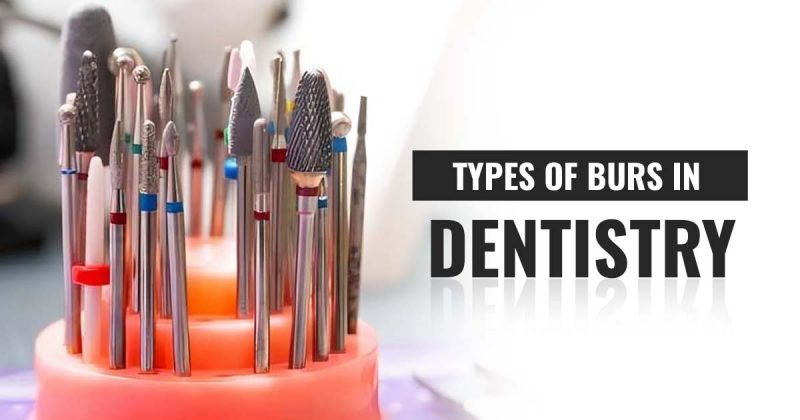
Dental burs are among the most frequently used rotary instruments in clinical dentistry. Their design, material, and shape directly influence cutting efficiency, surface finish, and clinical outcomes. A clear understanding of the different types of burs allows dental professionals to select the most appropriate instrument for each procedure, ensuring precision, safety, and optimal results.
This guide presents a structured overview of dental bur, their components, classifications, materials, and clinical applications.
What Is a Dental Bur?
A dental bur is a rotary cutting instrument attached to a dental handpiece, primarily used for cutting, grinding, shaping, and finishing dental hard tissues and restorative materials. Dental burs vary widely in design to accommodate different clinical requirements.
Key characteristics:
- They are designed to operate at varying speeds depending on the handpiece used.
- Their cutting efficiency depends on material composition, blade design, and grit size.
- They are essential in restorative, prosthodontic, endodontic, and surgical procedures.
Parts of a Dental Bur
A dental bur consists of three main components, each serving a specific functional role.

1. Shank
- The shank is the portion that fits into the dental handpiece.
- It determines the compatibility of the bur with different handpieces.
- Shank design ensures stability and concentric rotation during use.
2. Neck
- The neck connects the shank to the head of the bur.
- It provides clearance and visibility during cutting.
- Neck length varies depending on the intended clinical application.
3. Head (Blade)
- The head is the active cutting or abrasive portion.
- Its shape and surface determine the cutting pattern and finish.
- It is designed for specific procedures such as cavity preparation, finishing, or polishing.
Classification of Dental Bur
Dental burs can be classified based on several criteria, including handpiece compatibility, material composition, motion, head length, function, and shape.
1. Classification Based on Handpiece Attachment
Dental burs are designed to fit specific handpieces, ensuring proper rotational speed and torque.
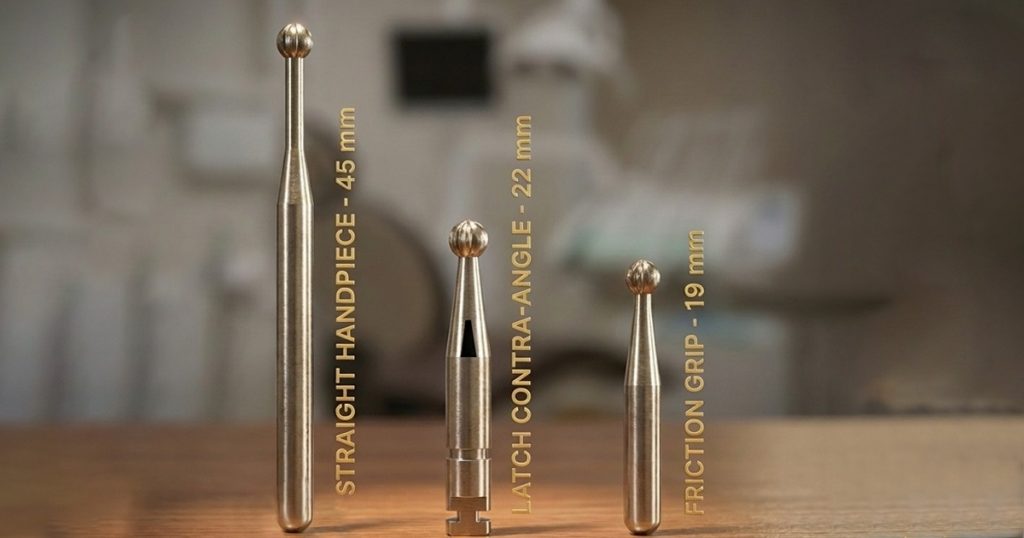
Straight Handpiece (HP) Burs
- Used primarily with straight handpieces at low speeds.
- Commonly utilized in laboratory procedures and surgical applications.
- Suitable for trimming acrylics, appliances, and prosthetic components.
Latch-Type (RA / Contra-Angle) Burs
- Designed with a latch mechanism for secure attachment.
- Operated at moderate speeds using contra-angle handpieces.
- Frequently used for finishing, polishing, and caries removal.
Friction Grip (FG) Burs
- Used with high-speed air turbine handpieces.
- Retained by friction without a latch mechanism.
- Ideal for precise cutting of enamel and dentin.
2. Classification Based on Material Composition
The material of a dental bur determines its cutting efficiency, durability, and clinical indication.

Stainless Steel Bur
- Manufactured from corrosion-resistant stainless steel.
- Best suited for cutting softer dental tissues such as dentin.
- Commonly used in slow-speed handpieces for finishing and trimming.
Tungsten Carbide Bur
- Made from a hard tungsten carbide alloy.
- Offer superior cutting efficiency and durability.
- Widely used for cavity preparation, caries removal, and crown sectioning.
Diamond Bur
- Coated with fine industrial diamond particles.
- Effective for cutting hard tissues like enamel and ceramics.
- Commonly used in crown preparation, veneer preparation, and finishing margins.
Ceramic Bur
- Constructed from advanced ceramic materials.
- Provide smooth cutting with reduced heat generation.
- Primarily used for finishing and polishing procedures.
3. Classification Based on Function
Dental burs are selected based on the specific task they are intended to perform.
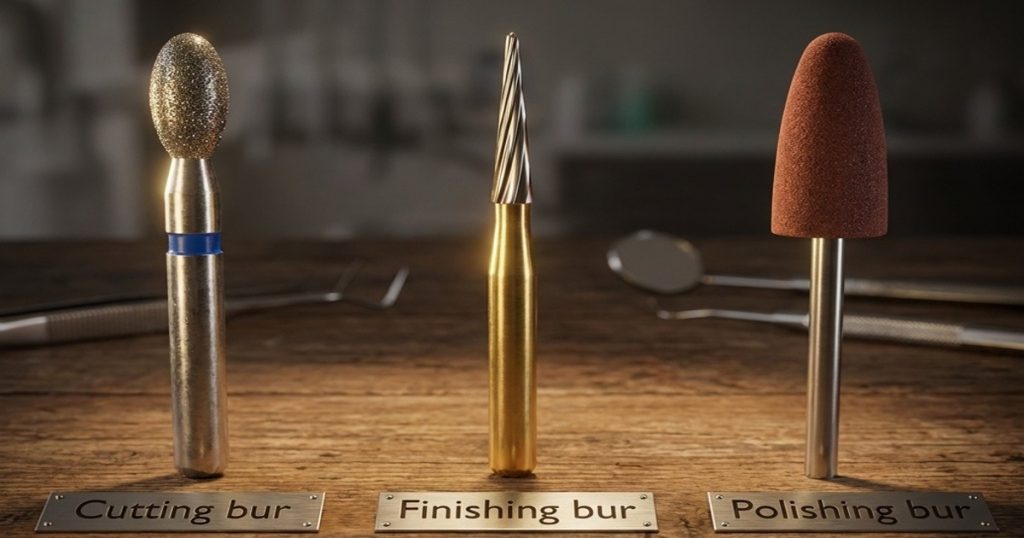
Cutting Bur
- Designed for rapid removal of tooth structure.
- Commonly used during cavity preparation and crown reduction.
- Available in carbide and diamond variants.
Finishing Bur
- Used to refine prepared surfaces.
- Help smooth margins and internal walls.
- Reduce surface irregularities before polishing.
Polishing Bur
- Used for final surface finishing.
- Improve aesthetics and reduce plaque retention.
- Commonly used on restorations and enamel surfaces.
4. Classification Based on Bur Shape
Bur shape determines the type of cut produced and the clinical application.
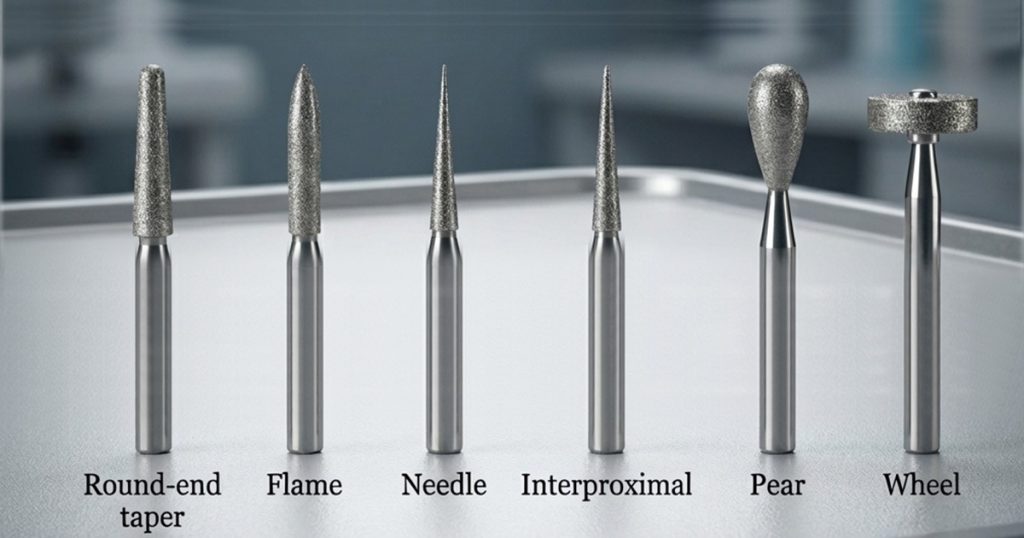
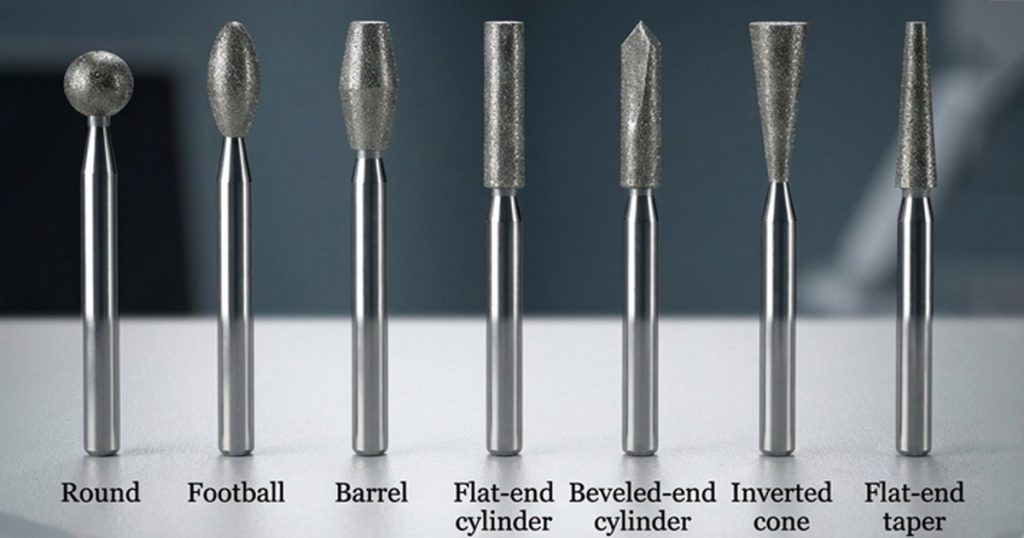
Round Burs
- Used for initial entry into tooth structure.
- Effective for caries removal and access preparation.
- Provide rounded internal line angles.
Inverted Cone Burs
- Designed to create undercuts.
- Commonly used for retention form in cavity preparation.
- Provide mechanical locking features.
Pear-Shaped Burs
- Used in amalgam cavity preparations.
- Facilitate smooth internal contours.
- Provide a balance between cutting efficiency and control.
Straight Fissure Burs
- Produce straight, flat walls.
- Commonly used for cavity outline form.
- Useful in crown and bridge preparations.
Tapered Fissure Burs
- Provide tapered cavity walls.
- Essential for indirect restorations.
- Improve path of insertion for crowns and inlays.
Wheel Burs
- Used for cutting flat surfaces.
- Commonly applied in crown margin refinement.
- Allow controlled reduction of tooth structure.
End-Cutting Burs
- Feature cutting edges only at the tip.
- Used for refining floors of cavities.
- Minimize damage to adjacent walls.
For a detailed explanation of dental bur shapes and their clinical uses, read our complete guide here: https://blogs.dentalkart.com/dental-bur-shapes-and-uses/
Importance of Selecting the Correct Bur
Choosing the appropriate dental bur is critical for clinical success.
- Enhances procedural efficiency and precision.
- Minimizes unnecessary removal of tooth structure.
- Improves surface quality and longevity of restorations.
Conclusion
Dental burs are fundamental instruments in everyday dental practice. Their wide range of designs, materials, and applications allows clinicians to perform procedures with accuracy and confidence. A thorough understanding of bur classification and selection ensures better clinical outcomes, reduced chair time, and improved patient care.
By selecting the right bur for each procedure, dental professionals can optimize performance while maintaining safety and precision in clinical dentistry.
FAQ’s
Carbide burs cut tooth structure using sharp blades and are highly efficient for dentin removal and cavity preparation. Diamond burs abrade surfaces using diamond particles and are preferred for enamel cutting, crown preparation, and finishing margins due to their controlled cutting action.
Friction grip burs are preferred during high-speed procedures such as crown preparation and cavity cutting. Latch-type burs are more suitable for low- to moderate-speed procedures like caries removal, finishing, and polishing.
Bur grit size directly influences the rate of tooth reduction and surface smoothness. Coarse grits are used for rapid reduction, medium grits for controlled shaping, and fine grits for finishing and margin refinement.
Dental burs should be replaced once cutting efficiency decreases or visible wear is present. Dull burs increase chair time, generate heat, and reduce precision, which can negatively affect clinical outcomes.
While some burs can perform multiple functions, using dedicated cutting, finishing, and polishing burs provides better control, surface quality, and clinical results.

No Comment