
Bulk-Fill Composites vs. Layering Technique: Which Gives Better Longevity?

Introduction
In modern restorative dentistry, the posterior composite is a staple of daily practice. For decades, the Incremental Layering Technique was the undisputed gold standard for managing polymerization shrinkage. However, the rise of Bulk-Fill Composites has challenged this tradition, promising to simplify workflows and save precious chair time.
The critical question for every clinician is: Does the speed of bulk-filling compromise the long-term success of the restoration? As it turns out, longevity is less about the material itself and more about how we manage the physics of light and resin chemistry.
Understanding the Techniques
To choose the right approach, we first must understand the “why” behind each method.
Layering Technique (Incremental Fill)
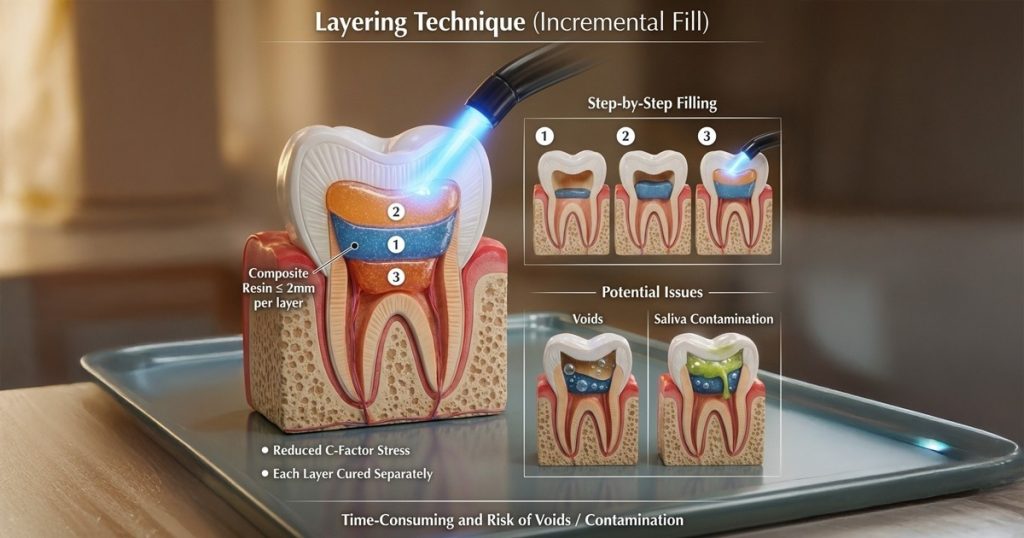
This traditional approach involves placing composite in increments no larger than 2 mm, with each layer cured separately.
- The Logic: By limiting the volume of resin cured at once, we reduce the Configuration Factor (C-Factor) stress. Each layer acts as a stress buffer, protecting the bond from being “pulled” away from the cavity walls.
- The Reality: While effective, it is time-intensive and increases the statistical risk of incorporating voids or saliva contamination between increments.
Products: Waldent NanoFill Zirconium Restorative Composite, Ivoclar Te-Econom Plus Composite Kit
Bulk-Fill Composites
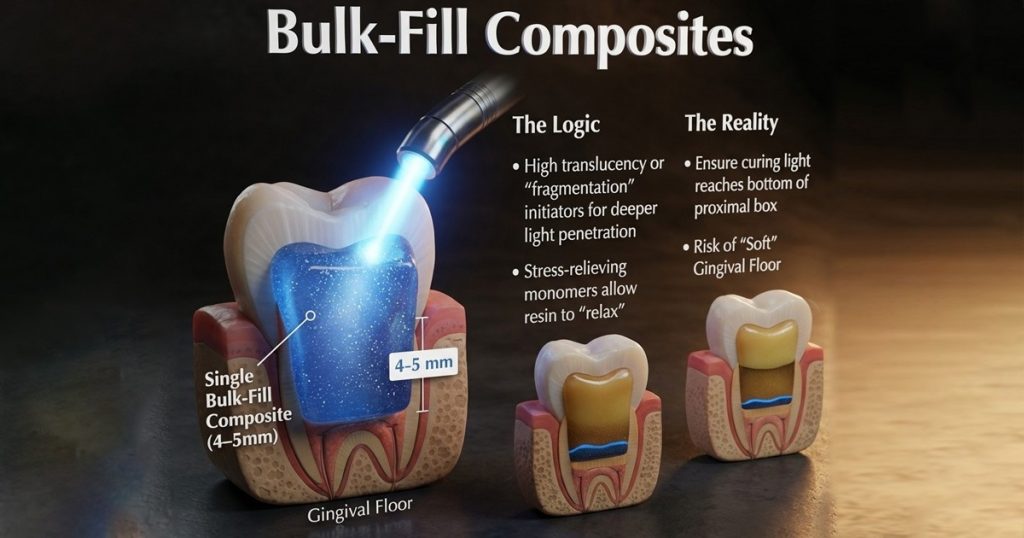
These materials are engineered to be placed in a single 4–5 mm block.
- The Logic: They utilize high-translucency resins or “fragmentation” initiators to allow light to penetrate deeper. Many modern versions include stress-relieving monomers that allow the resin to “relax” during the curing process.
- The Reality: The biggest challenge here is physics. You must ensure your curing light reaches the very bottom of the proximal box to avoid a “soft” gingival floor, which is a leading cause of secondary caries.
Product: Prime Dental Restorite Bulk Fill (Packable)
The Core Factors That Determine Longevity
Clinical Performance: Head-to-Head
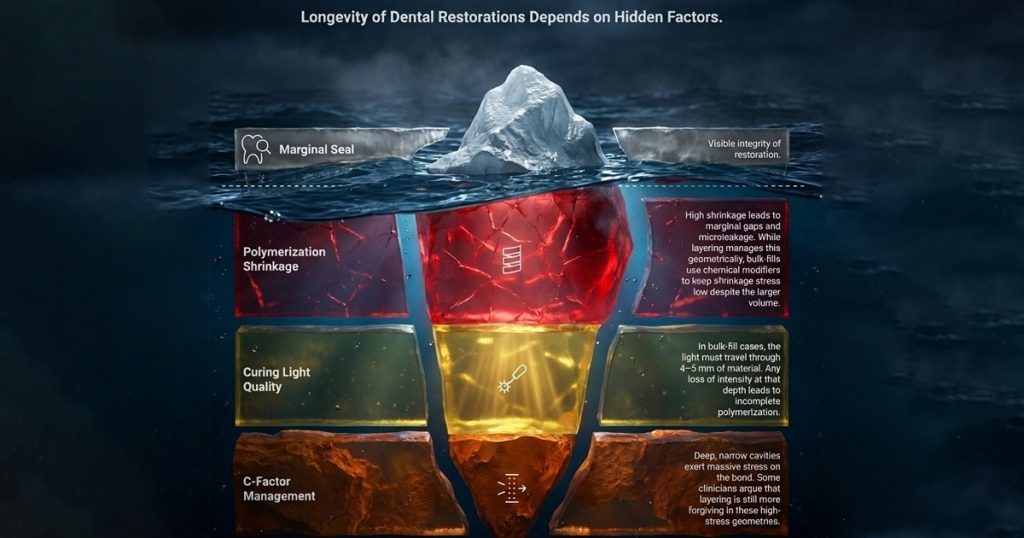
A common clinical assumption is that layering is the only way to manage shrinkage. However, modern material science has shifted the focus from total shrinkage to shrinkage stress.
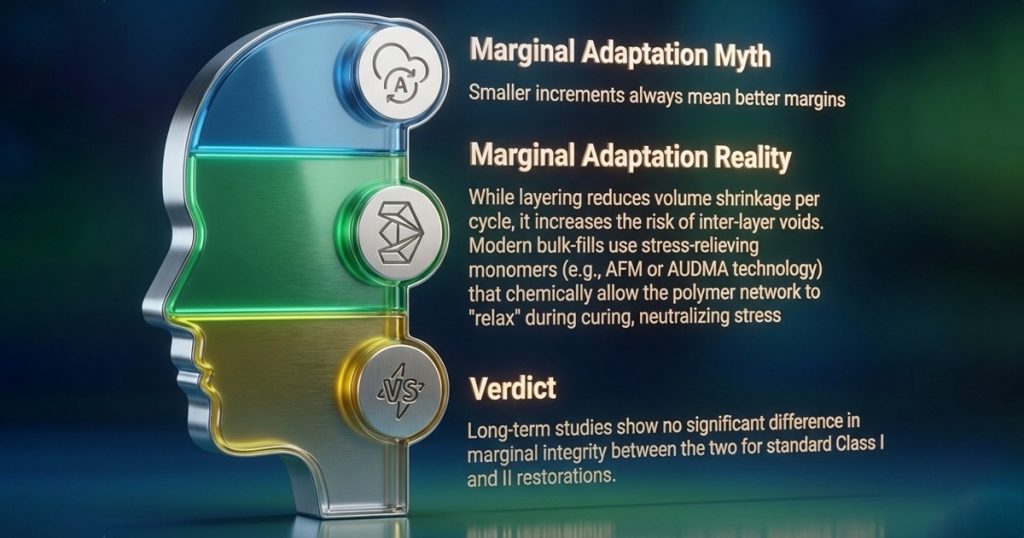
1. Marginal Adaptation: Technique vs. Chemistry
2. Post-operative Sensitivity

3. Internal Stress & The C-Factor

Comparison Table: Briefly
| Feature | Layering (Incremental) | Bulk-Fill Composites |
|---|---|---|
| Max Increment Depth | 2 mm | 4–5 mm |
| Shrinkage Management | Geometric (Technique) | Chemical (Material) |
| Chair Time | High | Low (Saves 40–50%) |
| Risk of Voids | Moderate | Low |
| Curing Sensitivity | Lower | Very High |
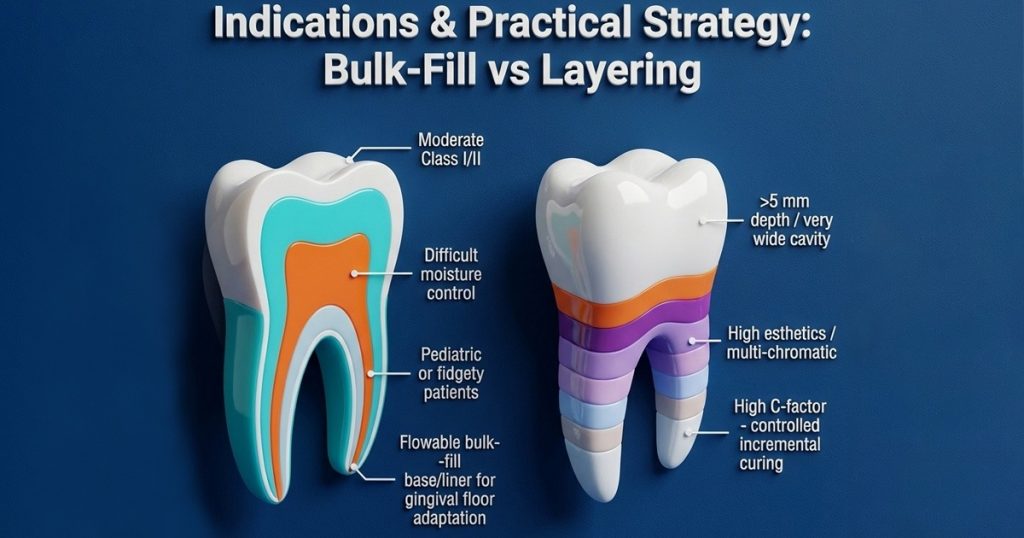
Indications & Practical Strategy
When to choose Bulk-Fill:
- Moderate Class I and II cavities where moisture control is difficult and speed is an ally.
- Pediatric patients or “fidgety” adults where chair time must be minimized.
- As a base/liner (using flowable bulk-fill) to ensure perfect adaptation to the gingival floor.
When to choose Layering:
- Very deep or wide cavities (>5 mm) where light attenuation is a concern.
- Cases requiring high esthetic characterization (multi-chromatic staining).
- High C-factor cavities where you want to manually manage the stress on each wall.
Product– Waldent NanoFlow Bulk Fill Flowable Composite, Xcem Merge Bulk Fill Composite – 11000
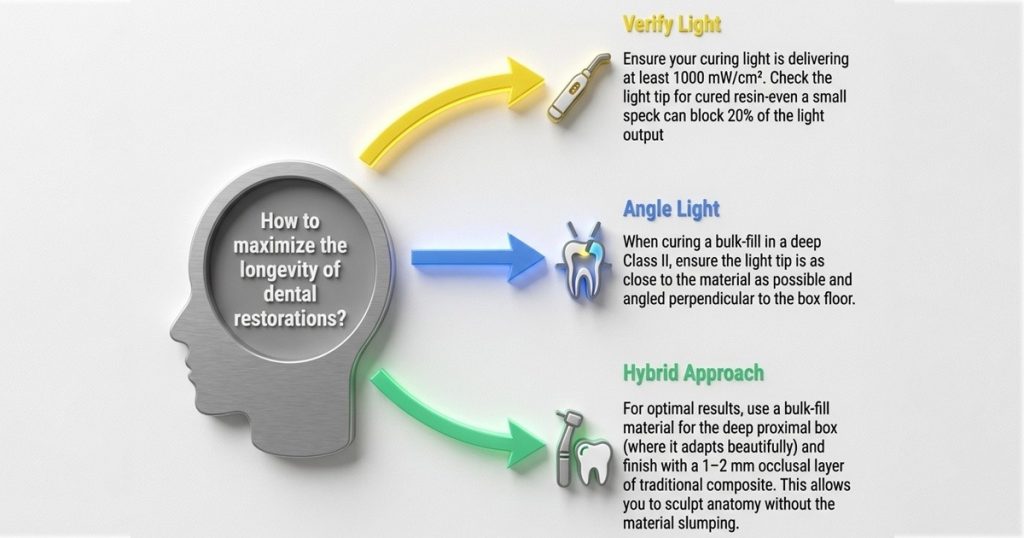
Did you know? Many “Bulk-Fill” materials are more translucent than traditional composites to let light through. This can sometimes result in a “greyish” finish. A popular pro-tip is to use a bulk-fill base and finish the final 1 mm with a traditional enamel layer for better esthetics.
Tips for Maximizing Longevity
Regardless of the material in your hand, these “Golden Rules” will protect your restorations:
Conclusion
Does speed compromise longevity? The evidence says no. Modern bulk-fill composites provide clinical outcomes comparable to traditional layering for most posterior cases.
While the layering technique remains a vital skill for complex or highly esthetic cases, bulk-fill technology offers a reliable, evidence-based way to improve efficiency without sacrificing quality. The “best” technique is ultimately the one that allows you to achieve a void-free, fully cured, and perfectly sealed restoration in that specific patient’s mouth.
FAQ’s
Bulk-Fill composites allow for placement in 4–5 mm increments, while the Layering Technique involves placing 2 mm layers and curing each separately to manage shrinkage stress.
The Layering Technique minimizes shrinkage stress by limiting the volume of resin cured at once, reducing the risk of the bond being pulled away from the cavity walls.
Bulk-Fill composites save 40–50% in chair time because they can be placed in a single 4–5 mm layer and cured at once, compared to the multiple increments needed for layering.
The biggest challenge is ensuring the curing light penetrates deeply enough, especially in proximal boxes, to avoid creating a soft gingival floor, which can lead to secondary caries.
Bulk-Fill is ideal for moderate Class I and II cavities, pediatric patients, or “fidgety” adults where speed is essential. It’s also useful as a base or liner to adapt to the gingival floor.


No Comment